Showing posts with label human rights. Show all posts
Showing posts with label human rights. Show all posts
Wednesday, September 12, 2012

Sunday, August 28, 2011
Anne Hutchinson

Anne also challenged notions that women were intellectually or spiritually inferior, that they ought not think for themselves, and that they were in a childlike relationship to their husbands, governors and religious leaders. Banished from the Massachusetts colony where she had sought religious freedom, and then banished again from the Rhode Island colony where she and like-minded friends had fled, she and all but one of her children were massacred by the very Natives she loved -- who did not know who she was and were in violent rebellion against the cruelty and greed of the white people who lived in the area.
In southern New York, the Hutchinson River is her namesake. It was while driving up the Hutchinson River Parkway with my young daughter years back that I noticed a bronze plaque on a stone bridge that mentioned the origin of the river's name. We looked up Anne Hutchinson when we got home and my daughter wrote a paper about her for an elementary school project. Anne Hutchinson not only served as an early role model for my daughter, her story has ever since inspired me immensely and her belief in the primacy of one's conscience in the search for truth and for a connection to a God sparked my first interest in learning more about Christian philosophy.
"As I understand it, laws, commands, rules and edicts are for those who have not the light which makes plain the pathway." --Anne Hutchinson
Anne Marbury was born in England and lived there until she was 43 years old, almost all her life. In her early years she was influenced by her father, a clergyman who did time in jail for protesting what he considered to be a nepotistic system of selecting church clergy, most of whom he considered to be unqualified. Anne was home-schooled and read from her father's libary. She clearly admired her father's assertiveness and ideals, learning to question church authority, to defend the right to live according to one's conscience and to speak out against corruption. She married William Hutchinson at the age of 21 and took on the role of wife and mother, but remained deeply interested in questions of theology. She and her family began attending the services of the Reformationist Reverend Joseph Cotton, a minister in the new Puritan movement that decried the corruption of the Catholic church.
In the year 1634, the Hutchinsons, and the 15 children Anne had borne, followed Joseph Cotton to the Massachusetts Bay Colony, the new Puritan stronghold in the New World. While the notion is commonly held that New England colonies were established according to the principle of religious freedom, the only "freedom" was for colony founders to establish and enforce their own preferred flavor of Christianity. Alternate beliefs were not tolerated. The stifling rules and religious interpretations laid down by colonial governors and their clerical cohorts were imposed on the entire colony. Further, the only acceptable role for women was to serve as child-bearers and submissive subjects of their husbands. Given the stultifying atmosphere vis-à-vis Anne's independent mind, she was destined to be in the role of agitator, dissenter, and branded woman throughout the tumultuous nine years that she lived in America.
When Hutchinson arrived in Massachusetts, there were religious discussion groups for men at which women were not welcome. So she started a discussion group of her own, for women. Rather than repeating the theology as preached and written down by men, she relied on her own deep study of the Bible and the resulting revelations to her own heart and mind, and brought those revelations into the discussion.
Some of her religious tenets were revolutionary for the times, going beyond the reforms the Puritans had built into their new religion. Whereas the leaders of the Massachusetts colony preached a "covenant of works," which laid out very specific actions and behaviors a person must adhere to in order to find salvation, Hutchinson believed in a "covenant of grace," in which humans are saved merely through their faith. These were beliefs she had learned from Rev. Cotton. But she was even more radical, and believed that faith was not about accepting Christ but rather was about recognizing that Christ had been in one's heart all along. And she stepped even further outside of accepted teachings, in that she believed in a personal closeness to God that did not require interpretation by, and was not a legitimate subject of judgement by, self-appointed church authorities. In her way of seeing it, God revealed himself to individuals without the aid of clergy.
Hutchinson's discussion groups were very popular. Soon men began to attend, too, and as many as 80 people were showing up to study with her. Her fearless independence of mind was a major challenge to the status-quo of the colony's leaders, as was her breaking of the strict Puritan mores that prohibited men and women meeting together, and the fact that so many women were stepping away from their families briefly in order to attend her meetings. This led to her being brought up on charges of heresy and she stood trial twice, while in an advanced pregnancy once again, 50 years before the Puritan misogyny reached its peak with the Salem witch trials.
Hutchinson represented herself at both her civil and church trials, never wavering, never showing fear, and responding to charges with rejoinders that showed shrewd understanding of the law, astute insight into the hypocrisy of the patriarchal control of women's lives, and incredible allegiance to her own truth. The key charge against her in the civil trial was that she had violated the Fifth Commandment, in an argument that cast the "fathers of the colony" as parents. Thus, in a classic use of church doctrine as a means for the powerful to maintain the status quo, she was branded as a heretical dissenter and banished from the colony -- but not before she also had to stand a religious trial in which she was accused of "lewd and lascivious conduct" for holding meetings whose attendees were both men and women. The result of this trial was excommunication.
Anne, William and their children fled to the colony of Rhode Island which at first was a haven for people who had stepped outside of Puritanical rule, yet quickly became yet another example of a powerful man instituting harsh theocratic policies. By this time Anne was led by her experience, logic and meditations on Scripture to a philosophy of individualist anarchism, in which individuals are free to evolve their own morality, ideology, and religious beliefs. (Note that William Gibson, born more than a hundred years later, is credited with being one of the early influences on the school of individualist anarchism, whereas Anne Hutchinson had arrived at a similar set of socio-religious-political beliefs on her own under the most contrary circumstances possible.)
William died in 1642 and Anne decided to move once again, this time to the Dutch-held colony of Eastchester Bay (now in the Bronx). Some of her friends and family moved with her, which attests to her strength as a thought-leader. In 1643 she, her servants, and all but one of the five children who had moved with her were massacred by Mahican Indians who were in rebellion against the local Dutch colonists.
In 1987, Massachusetts Governor Michael Dukakis pardoned Anne Hutchinson, revoking the order of banishment by Governor Winthrop 350 years earlier.
Sources:
http://en.wikipedia.org/wiki/Anne_Hutchinson
http://www.annehutchinson.com (this site includes partial transcript of her trial, worth a look!)
http://www.encyclopedia.com/topic/Anne_Hutchinson.aspx

Sunday, August 14, 2011
Suraya Pakzad

In 2009, when she was one of the first four women to receive a "Power and Peace Award" (one of several high honors she has earned), the Washington Post explained the kind of violence Pakzad witnessed in her youth, that led her to follow her mission of working for women:
Suraya Pakzad was 12 when she saw a gunman kill the headmistress of her Afghan school because the woman taught girls and refused to wear a headscarf. A few weeks later, a rocket smashed into the school and killed a student sitting near her, another warning for girls not to learn.In addition to her open efforts towards educating women and teaching them skills and trades (she is the only woman in Afghanistan who has ever trained other women to run a restaurant, for example), she also runs a system of secret shelters for child brides and other victims of Taliban-style abuse of women, providing housing and medical, legal and job-training services.
Pakzad was named in 2009 by Time magazine as one of the "Time 100" most influential people in the world. A mother of six children, she lives with unimaginable daily risk. She has been the victim of many death threats and conservative influences within the government have worked against her good efforts. Funding is also a constant challenge.
The write-up of Pakzad in Time 100 noted:
It is difficult to name a more committed advocate for women's rights in Afghanistan.... Pakzad knows that any future success for Afghanistan depends greatly on the full, unimpeded participation of its women as contributing, productive members of society. In 1926, then Queen Soraya said famously, "Do not think, however, that our nation needs only men to serve it. Women should also take their part, as women did in the early years of Islam. The valuable services rendered by women are recounted throughout history. And from their examples, we learn that we must all contribute toward a development of our nation." This is what Pakzad believes. This is what she fights for. And it is — and this, however unpleasant, must be said — what she may die for.
Sunday, July 17, 2011
Lisa Shannon and Fartun Abdisalaan
The Awesome Women of the Day are Lisa Shannon and Fartun Abdisalaan, who together are working to improve the lot of women in Mogadishu, Somalia, which was "recently named one of the five worst places to be female" and is a place where few on this earth would choose to visit, never mind work. They are being honored today for risking their lives and giving up Western comfort in order to advocate for the human rights, health, safety, opportunity, education, and well-being of women in one of the hardest hit places on the planet.

In an article penned by Shannon, "In Mogadishu: A Lifeline For Somali Rape Victims"
in The New York Times this week, she leads off:
AWU post and comments at http://www.facebook.com/photo.php?fbid=2257806124896&set=oa.10150302820643055&type=1
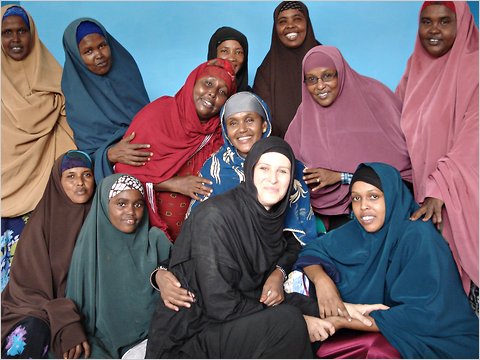
Lisa Shannon, center and in black, and Fartun Abdisalaan Adan, in blue directly behind her,
surrounded by participants in the new organization Sister Somalia,
which helps Somali victims of gender-based violence.
surrounded by participants in the new organization Sister Somalia,
which helps Somali victims of gender-based violence.
In an article penned by Shannon, "In Mogadishu: A Lifeline For Somali Rape Victims"
in The New York Times this week, she leads off:
“Why did you come here when no one else does?” The African Union communications director asked us over dinner at its compound in Mogadishu. Good question. We were warned against it, especially by war-zone regulars. It’s been called the most dangerous city—or place—on earth. In fact, we had to delay our trip for two weeks due to multiple suicide bombings and riots inside the area controlled by Mogadishu’s transitional government (TFG). So, why go? I gave the short answer, “We’re supporting a local social entrepreneur in launching a sexual violence hotline.”
But the real answer was more complicated. Somalia bothers me. The 1993 Black Hawk Down incident was tragic not only for the loss of United States servicemen, but because many experts credit this loss with a shift in American public sentiment and policy toward mass atrocity in Africa. In effect, we collectively flipped off our empathy switch, approaching African crises like Rwanda, Congo and Darfur as “Operation Not Worth It.” But no country has been more written off than Somalia. And in Somalia, no group has been more written off than women.Abdisalaan's husband, Elman, was a human rights worker who was murdered in 1996. After escaping to Canada to raise her children there, she returned to Mogadishu in 2007 to continue his work and is the founder of the Elman Peace and Human Rights Center. Counseling and other services are provided to the survivors of gender violence, the nearly universal female genital mutilation practiced in Somalia, and all sorts of struggles the women endure due to the chaos and conflicts in their country.
And then there is Al-Shabab. The radical, militant Islamic group linked to Al-Qaeda rules 90% of central and south Somalia with utter impunity. Not only do they abduct and imprison through forced marriage, terrorize and gang rape. If women complain, they are often accused of adultery and speaking against the brotherhood, punishable by death. The execution methods of choice: Stoning or beheading.Abdisalaan founded Sister Somalia, a program in collaboration with Shannons' new organization, A Thousand Sisters, which offers the only sexual violence hotline in Mogadishu, provides counseling, business startup advice, and also works to move survivors and their children away from their attackers. "Each woman who walks through the door will also receive a letter from a 'sister' abroad," writes Shannon. "We hope to raise $120,000 per year to make it happen. How is a broke activist like me planning to pull this off? Just like every stage of my journey with Congo, I don’t know exactly. But I’m betting we can find at least 1,000 Americans who would welcome the opportunity to show up for women in Somalia, through writing a letter or giving at least $10 per month."
AWU post and comments at http://www.facebook.com/photo.php?fbid=2257806124896&set=oa.10150302820643055&type=1
Friday, July 15, 2011
Joan Baez

Awesome Woman of the Day is Joan Baez, (b 1941) Joan Baez is a singer who possesses one of the most incredibly beautiful voices of our time. She was a full fledged member of the 60s folk movement. She introduced Bob Dylan to audiences (and was romantically involved with him for several years) and and influenced singers such as Emmylou Harris and Bonnie Raitt.
This very talented woman throughout her career gave unselfishly of her time and resources to causes she believed in.
Her first act of civil disobedience was in high school when she refused to leave her classroom for an air raid drill, believing the bomb scares were government propaganda. She was also active in the Free Speech Movement at UC Berkeley.
In the 1950s after hearing Martin Luther King speak about civil rights and social justice, and the nonviolent movement, was so moved that she marched with Dr. King and demonstrated with him at many civil rights demonstrations including the march from Selma to Montgomery.
She performed “We Shall Overcome” at the 1963 March On Washington. Her recording of “Birmingham Sunday” was used in spike Lee’s “4 Little Girls”
In 1966 the worked with Cesar Chavez for the migrant farm workers and preformed at a benefit on their behalf.
In the anti-war movement Ms Baez was a vocal and active supporter. She advocated withholding taxes used for war and withheld sixty percent of her own. She founded the Institute for the Study of Nonviolence and encouraged draft resistance. Her husband David Harris went to prison for resisting the draft.
Joan held a free concert at the Washington Monument in 1967 protesting the war. It was attended by 30,000 and opposed by the DAR. She marched and demonstrated in many anti-war protests, ending with the “War Is Over” celebration in 1975. When she visited North Viet Nam in ’72 to deliver Christmas mail to POWs and was distressed at the level of human rights violations. Unlike some on the left at that time, she organized a full page advertisement of those atrocities. Ms Baez has been a staunch critic of human rights violations of countries on both left and right. In Chile, Brazil and Argentina she was prevented from performing and subjected to death threats. She has traveled the world bringing food and medicine to troubled regions.
Joan has been a fierce advocate for Gay and Lesbian rights since the late 70s. As in her other causes, she has appeared and organized benefits for them.
In 2006 Joan received the Distinguished Leadership Award from the Legal Community Against Violence for her lifetime of work against violence.
Joan Baez has been and continues to bring light to dark places, and, by the way, continues singing.
AWU post and comments at http://www.facebook.com/groups/343338393054?view=permalink&id=10150314428918055
Monday, June 27, 2011
Flor Molina

Molina's coworker picked her up, took her to a restaurant, and contacted the FBI who were already investigating the trafficker. The FBI connected her to the Coalition to Abolish Slavery and Trafficking (CAST), who helped her find shelter and get back on her feet. She then became a member of the CAST Survivor Advisory Caucus, one of the groups that worked hard to pass a bill in California (that will go into effect in 2012) that requires manufacturers and retailers in the state to disclose their efforts at making sure their supply chains are free of slavery.
Molina offered the final testimony in the California legislature while Governor Schwarzenegger's pen was poised over the bill:
I and other members of the caucus speak up against slavery not because we are not afraid but because we want to make sure that what happened to us doesn't happen to anyone else.
The CAST Survivor Advisory Caucus fought hard for this bill to pass. We testified at hearings, we wrote letters and got signatures for our petition. Our voices were heard and action was taken, action that will, hopefully, protect others from falling prey to traffickers like we once did. I am proud to stand here, not as a victim of slavery but as a powerful agent of change.
Please, Governor Schwarzenegger, will you please sign the legislation?
There was applause, and the Governor signed.
http://www.szone.us/f76/governor-highlights-legislation-combat-human-trafficking-51387/
http://thecnnfreedomproject.blogs.cnn.com/2011/04/05/i-was-enslaved-for-40-days/
AWU post and comments at http://www.facebook.com/home.php?sk=group_343338393054&view=permalink&id=10150288318793055
Tuesday, May 3, 2011
Judi Bari

AWU post & comments at http://www.facebook.com/home.php?sk=group_343338393054&view=permalink&id=10150233078753055
Subscribe to:
Posts (Atom)